
Projects and Construction: Tax Calculation in Change Orders
In construction, change orders are legally binding amendments to project agreements. To keep contractors and customers aligned and to avoid disputes, it’s critical to clearly communicate both the total revenue impact and the calculated taxes.
Starting in MYOB Acumatica 2026.1.1, you can review the full financial impact of a change order—including taxes—before you send it to the customer. You can calculate sales tax or GST for a change order by using the system’s internal tax functionality or through an external tax provider.
When you print or email a change order, the printable document now includes the tax amount so that customers can clearly see it as part of the change order total.
- Tax calculation applies only to revenue budget lines of change orders.
- Only taxes of the Sales or GST type are supported for change orders.
- The new functionality depends on enabling GST Reporting for GST on the Enable/Disable Features (CS100000) form.
Specifying a Tax Category for Change Order Lines
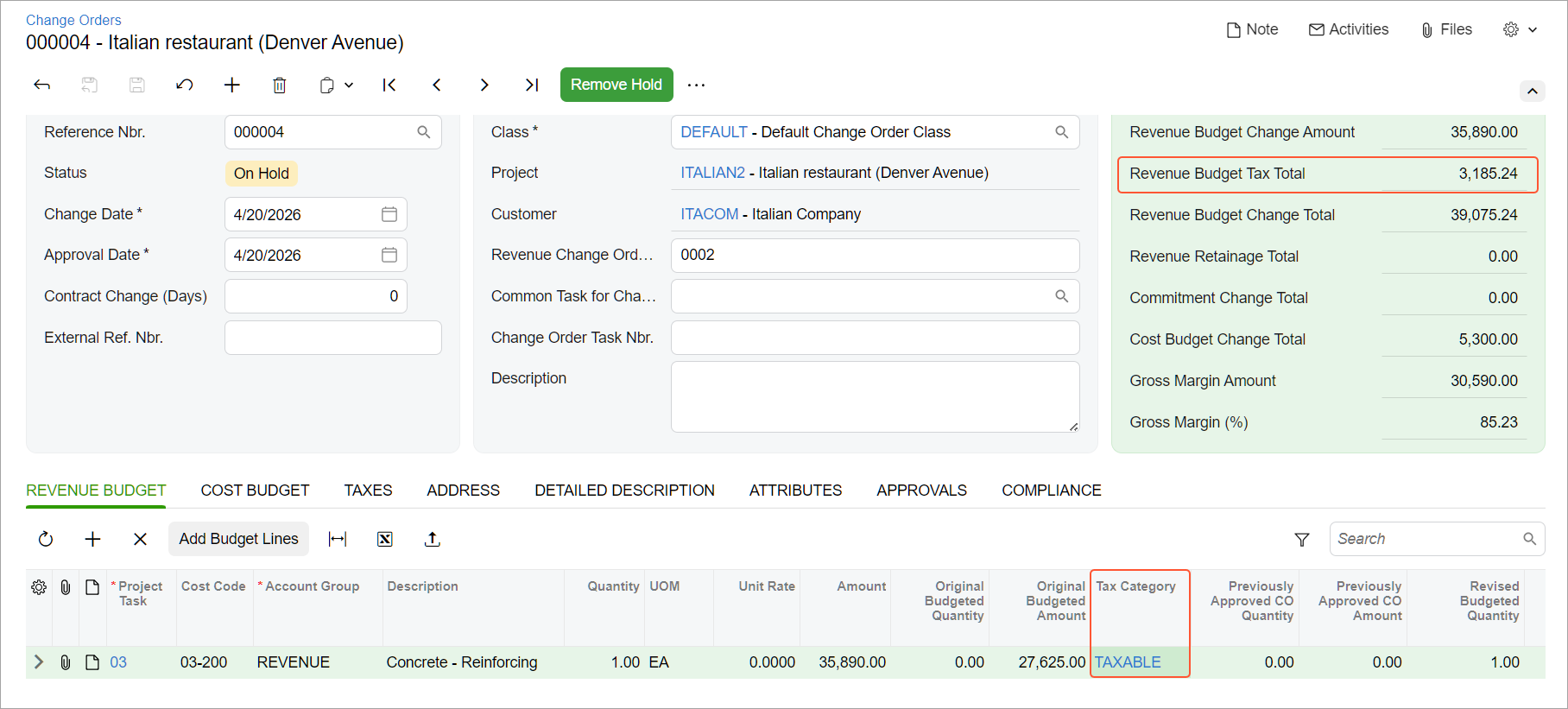
When taxes have been configured, you can specify a tax category in the new Tax Category column on the Revenue Budget tab of the Change Orders (PM308000) form for each line, as shown below. Taxes are calculated for only the revenue budget lines with a tax category specified.
Reviewing Taxes in Change Orders
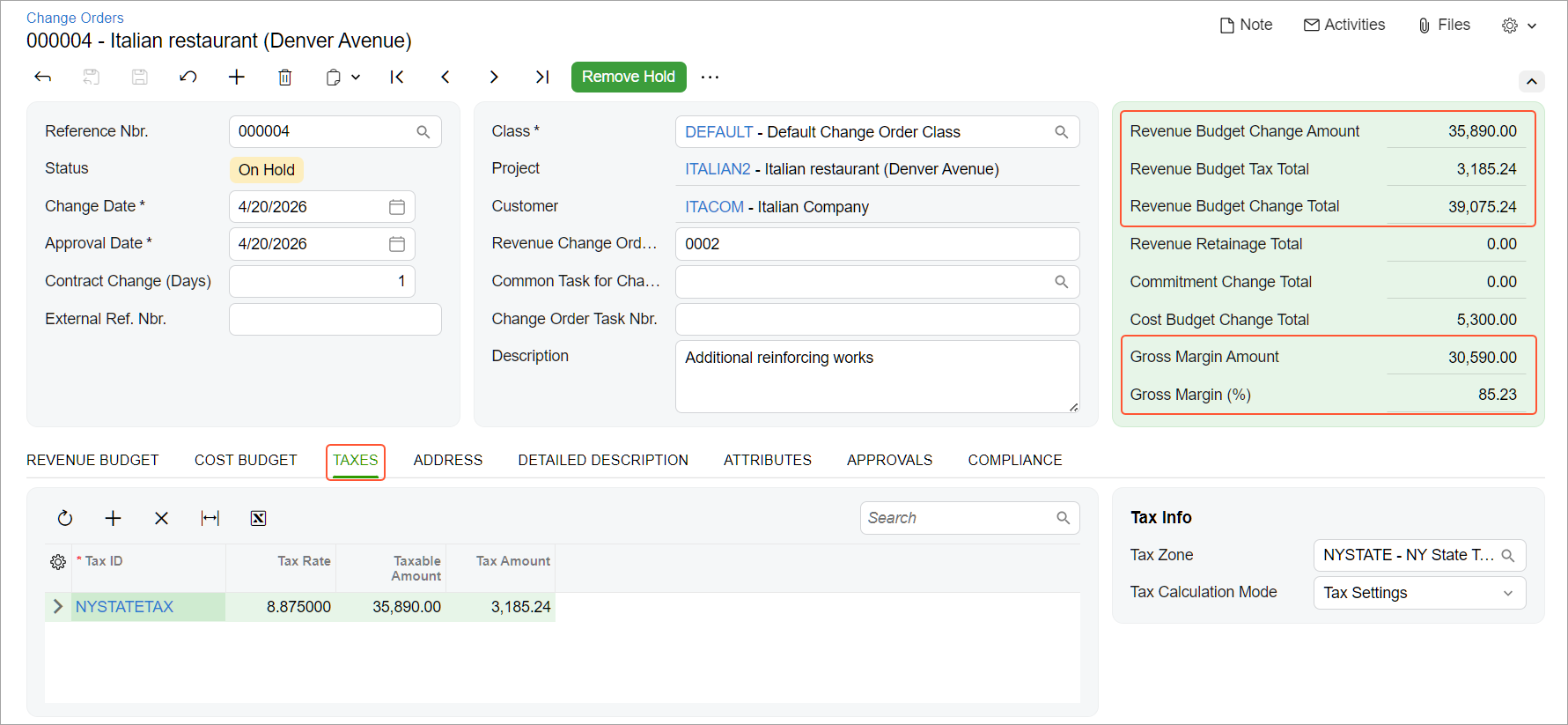
If sales taxes or GSTs are configured, you can review calculated taxes on the new Taxes tab of the Change Orders (PM308000) form. In the Tax Info section of the tab, you can view (and change, if needed) the tax zone. In the Summary area of the form, you can view the following amounts of the change order, as shown below:
- Revenue Budget Change Amount (new box): The revenue amount before taxes for exclusive taxes or the revenue amount with taxes for inclusive taxes
- Revenue Budget Tax Total (new box): The calculated tax amount
- Revenue Budget Change Total: The total revenue amount, including tax
Note that the amounts in the Gross Margin Amount and Gross Margin (%) boxes of the Summary area are now calculated based on the revenue amounts before taxes. This calculation ensures more accurate profitability analysis.
Taxes are automatically recalculated on the Change Orders form when you modify:
- The amounts or tax categories in change order lines on the Revenue Budget tab
- The tax settings on the Taxes tab
Calculating Retained Taxes
Suppose that your customer retains a part of the amount of invoices prepared for change orders. To reflect this, you’ve enabled the Retainage Support feature on the Enable/Disable Features (CS100000) form.
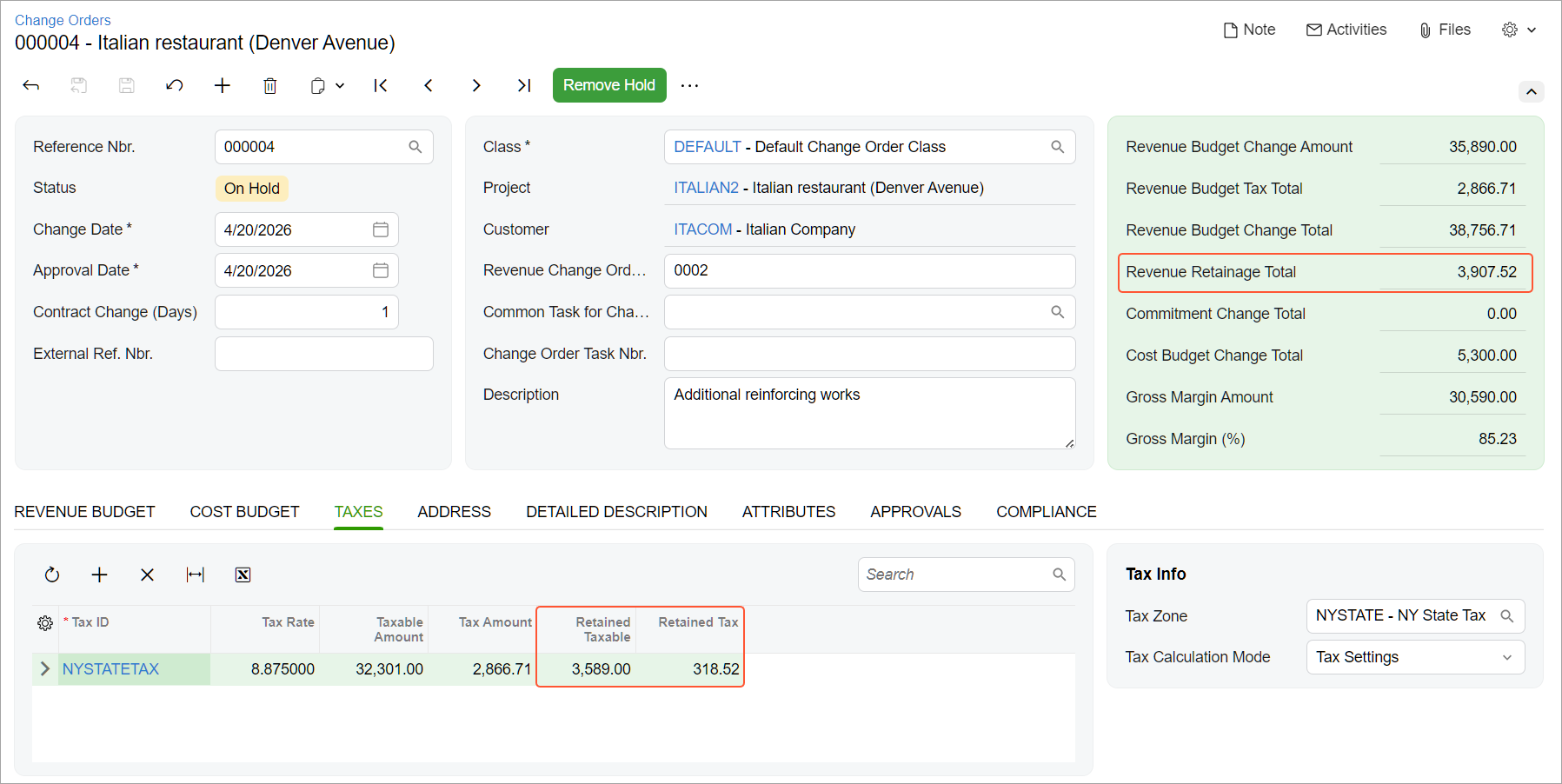
Retained amounts are calculated on the Revenue Budget tab of the Change Orders (PM308000) form. If you specify the retainage percent for revenue budget lines, the system calculates:
- The retained taxable amount and retained tax amount on the Taxes tab if the Retain Taxes check box is selected on the Accounts Receivable Preferences (AR101000) form
- The retained revenue change amount in the Revenue Retainage Total box of the Summary area
Applying Taxes Calculated by External Tax Providers
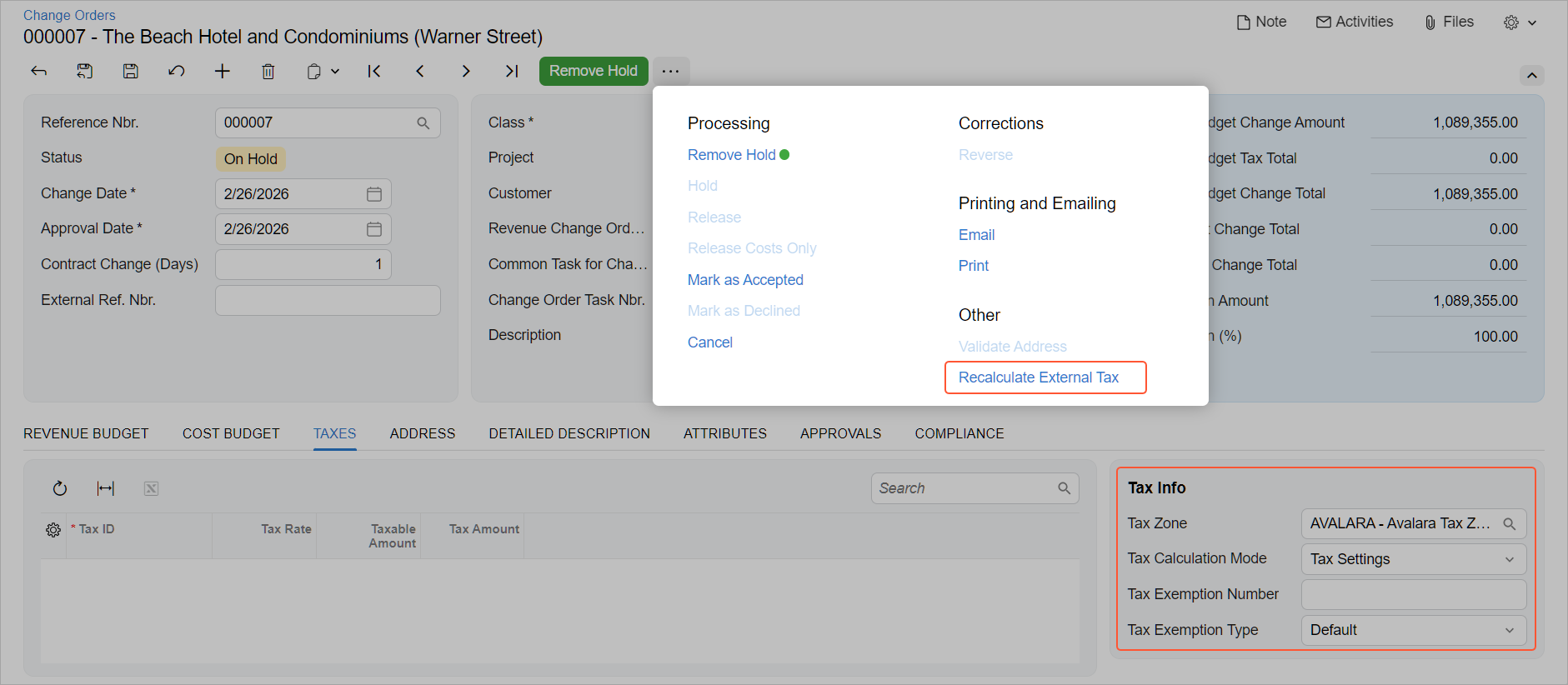
Your company may be calculating taxes by using an external tax provider, such as Avalara AvaTax or Vertex. Taxes are calculated for a change order on the Change Orders (PM308000) form when you do any of these:
- Save the change order
- Release the change order
- Click the new Recalculate External Tax command on the More menu (see below)
You can review the tax settings and the calculated taxes on the Taxes tab.
For details, see Integrating MYOB Acumatica with Avalara Avatax and Integrating MYOB Acumatica with Vertex Tax Provider.
Printing and Emailing a Change Order with Tax Amounts
When you're ready to share a change order with the customer, you can print or email the Change Order (PM643000) report. This print-friendly document now has these amounts, as shown below:
- Change Order Amount
- Change Order Tax Amount
- Change Order Total
In the Owner section of the printable document, you can view the change order's address, which is copied from the Address tab of the Change Orders (PM308000) form.
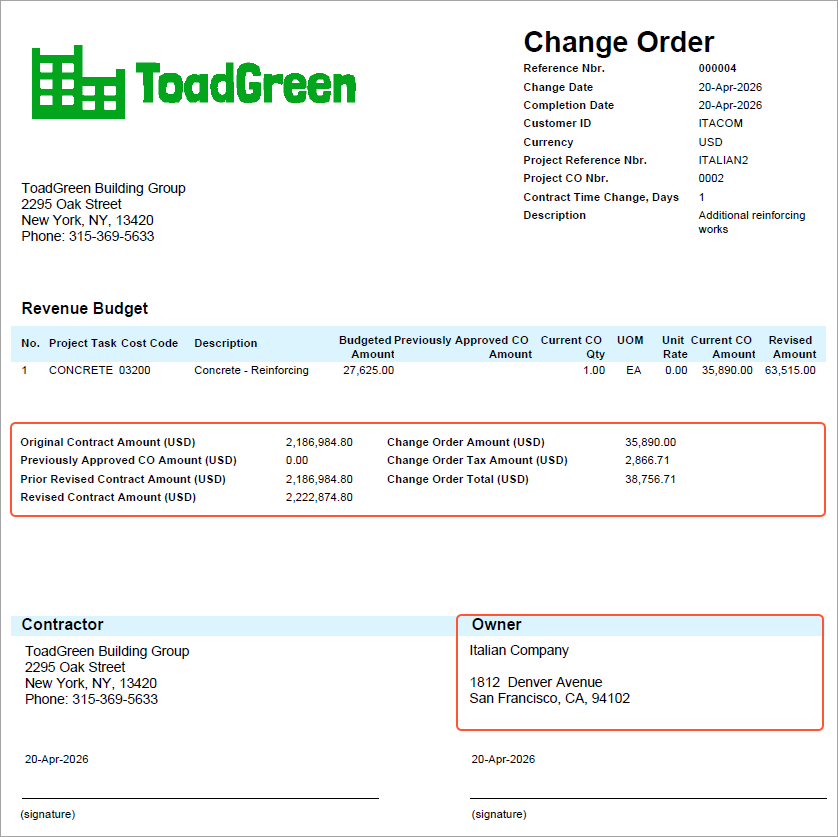
- Original Contract Amount, which was called Original Revenue Budget Total
- Previously Approved CO Amount, which was called Previously Approved CO Total
- Prior Revised Contract Amount, which was called Prior Revised Revenue Budget Total
- Revised Contract Amount, which was called Revised Revenue Budget Total
Viewing the Calculated Taxes for a Project
Suppose that you've created a new project task from a change order on the Change Orders (PM308000) form. You've added a taxable revenue budget line and specified the retainage percentage in this line.
When you take this change order from hold, the system will:
- Create a new project budget line
- Copy the retainage percent and tax category to the Tax Category and Retainage (%) columns on the Revenue Budget tab of the Projects (PM301000) form
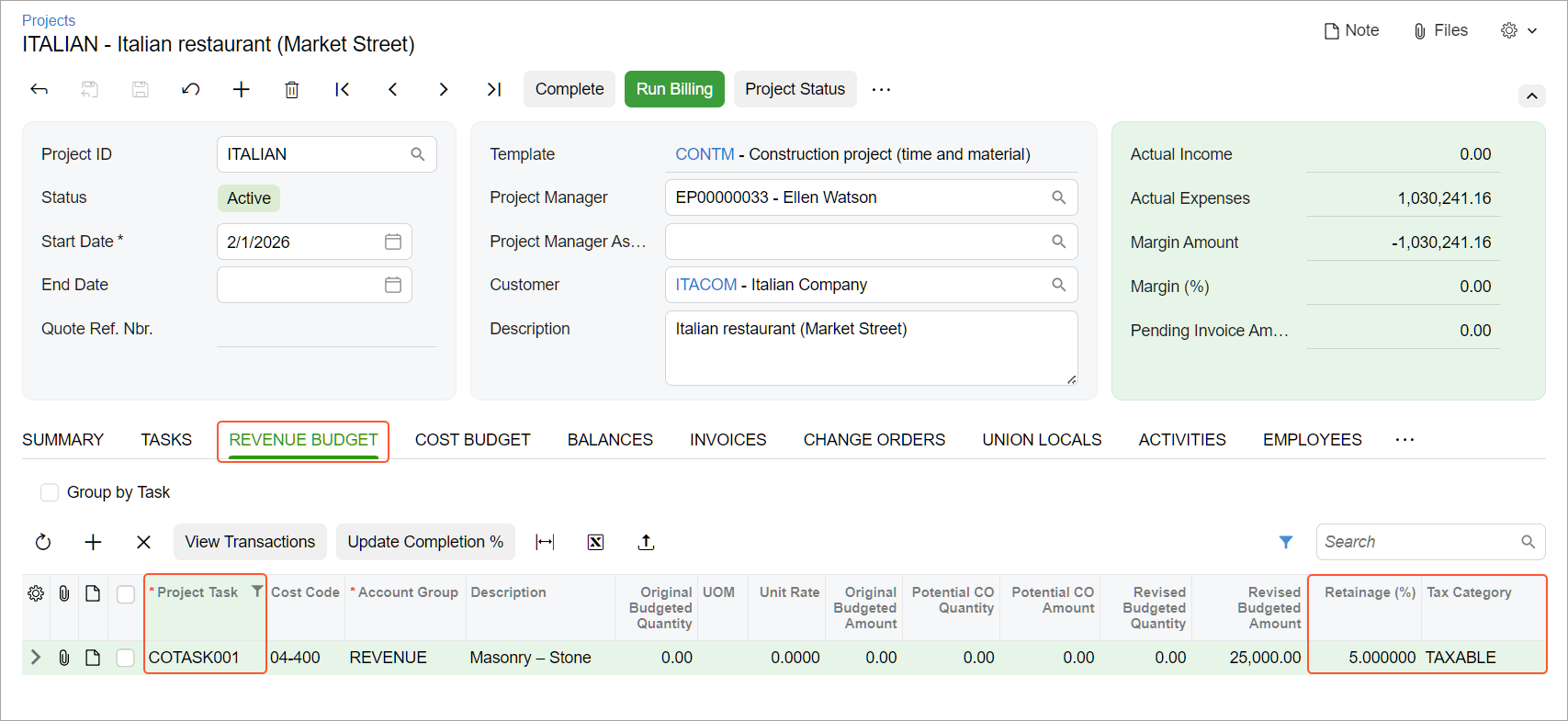
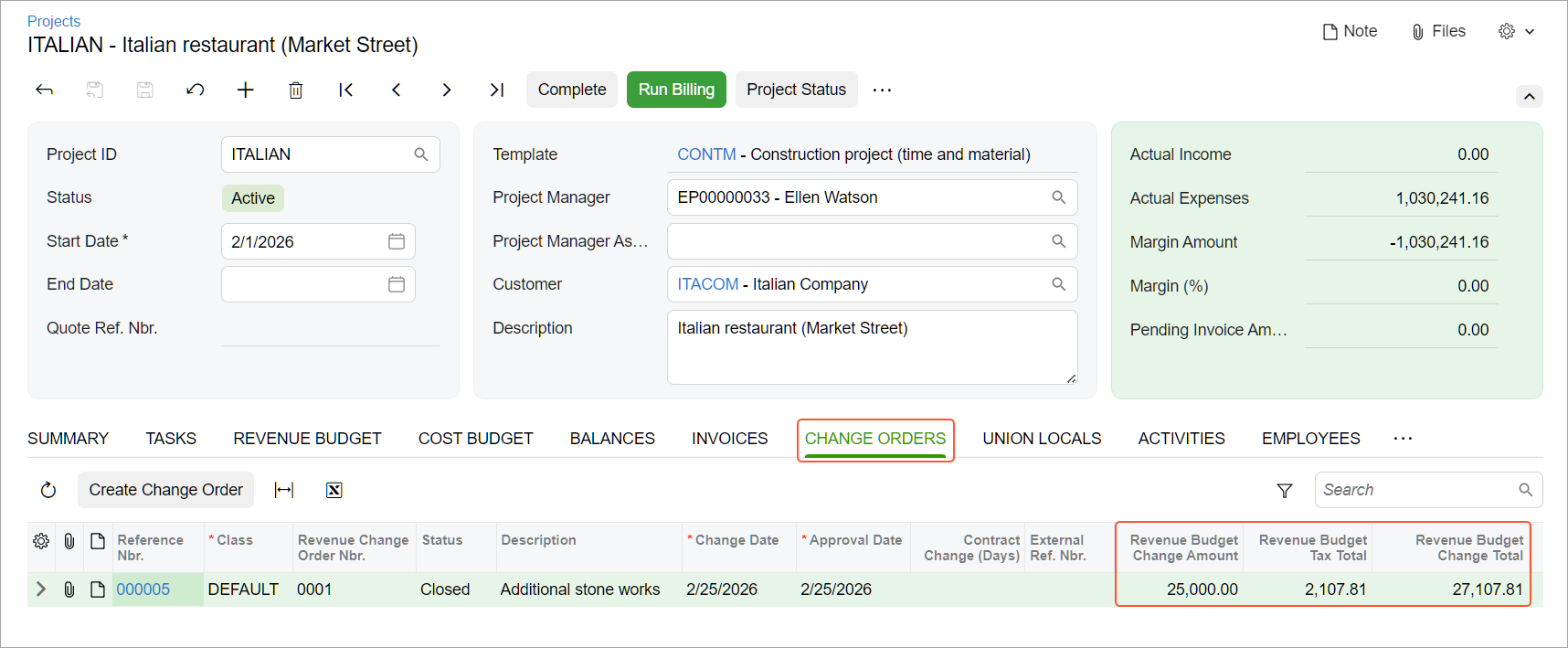
On the Change Orders tab, you can review these amounts for each change order:
- Revenue Budget Change Amount: The revenue amount before taxes for exclusive taxes or the revenue amount with taxes for inclusive taxes
- Revenue Budget Tax Total: The tax amount calculated for the change order
- Revenue Budget Change Total: The change order amount, including tax
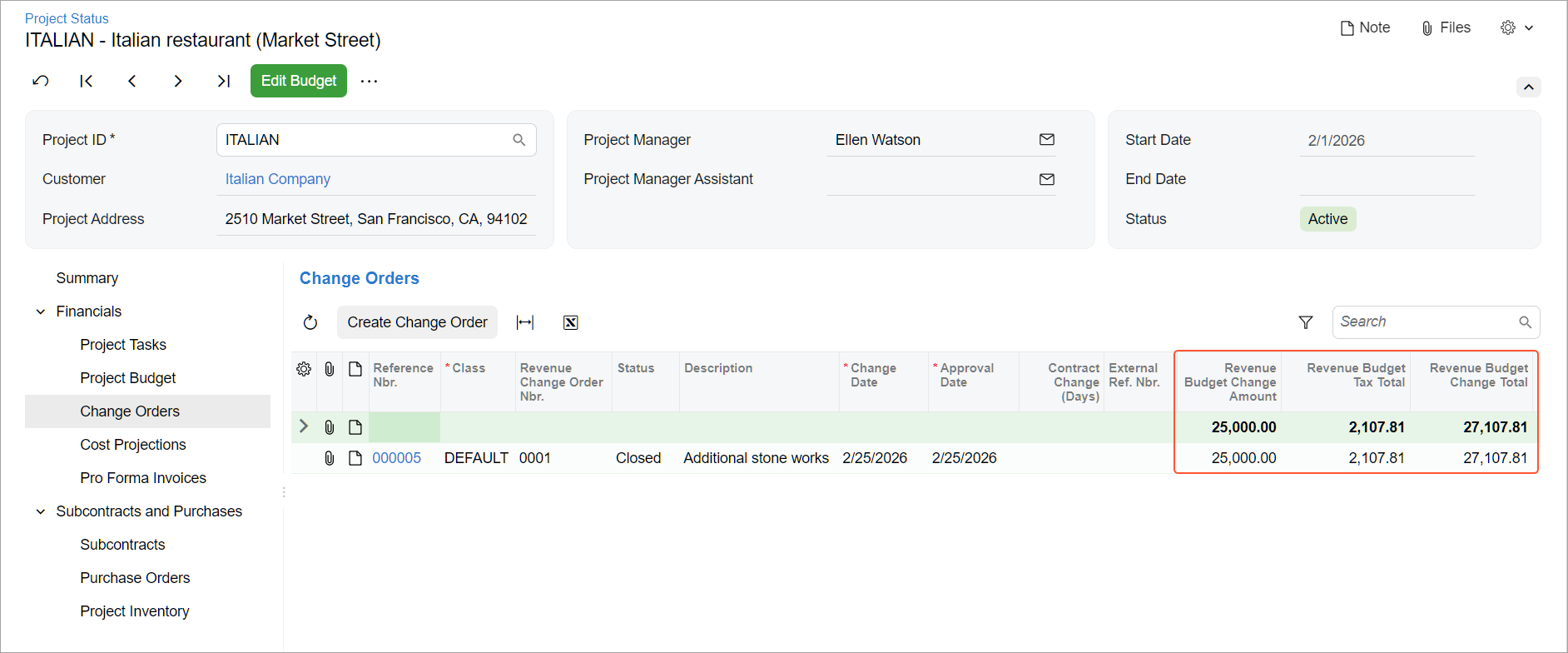
On the Project Status (PM301500) form, you can also review these column amounts.
Reversing a Change Order with Taxes
When you reverse a change order, all tax-related settings are copied from the original change order to the reversing change order—the one that’s reversing the original order. These settings include:
- The tax zone
- The tax categories
- Address information
- The tax exemption number and tax exemption type if the customer is tax exempt
- The tax calculation mode if the Net/Gross Entry Mode feature is enabled on the Enable/Disable Features (CS100000) form
Line amounts on the Revenue Budget tab of the Change Orders (PM308000) form become negative, and taxes are automatically recalculated on these negative amounts. This results in negative tax values that reverse the tax impact of the original change order.
Key Capabilities
- Prepare a change order with the tax included before you send it to the customer, ensuring that the approved change order amounts match the project invoice amounts.
- Calculate the sales tax or GST in a change order by using the taxes configured in the system or calculated through an external tax provider.
- Print or email change orders that include the tax and total amounts, speeding up change order and invoice approvals.