
Finance: Select Fixed Assets Depreciation Method by Period
Sometimes your company decides to adopt a new depreciation approach that will start next year or next quarter. With MYOB Acumatica 2026.1.1, you can schedule the change so that the system continues from that point forward without recalculating past depreciation.
You can now plan depreciation method changes for fixed assets by period. When you switch methods for future periods, previously posted depreciation is left as-is, past periods aren’t recalculated just because you’ve changed the method going forward. For each fixed asset book, you maintain a list of applicable depreciation methods. Each method has its own Start Period, which determines when it takes effect.
This change is also useful when migrating to , as you can now import fixed assets registers from other systems without recalculating historic depreciation over the whole life of the asset.
Read on to learn how to set up and use this functionality.
Supported Depreciation Methods
Multiple-method scheduling is available for the depreciation methods that have been migrated to the new depreciation engine. The table below lists these methods and their averaging conventions.
| Depreciation Method | Averaging Convention |
|---|---|
| Straight-Line | Full Period |
| Straight-Line | Full Day |
| Australian Prime Cost | Full Day |
| Australian Diminishing Value | Full Day |
| New Zealand Diminishing Value | Full Period |
| New Zealand Straight-Line | Full Period |
| Dutch Method 2 | Full Period |
| Remaining Value by Days in Period | Full Day |
| Remaining Value | Full Period |
Setting Up Multiple Depreciation Methods
The setup of multiple depreciation methods involves two key steps:
- Update the fixed asset preferences.
On the Fixed Assets Preferences (FA101000) form, select the Allow Multiple Depreciation Methods check box.
Figure 1. The new check box 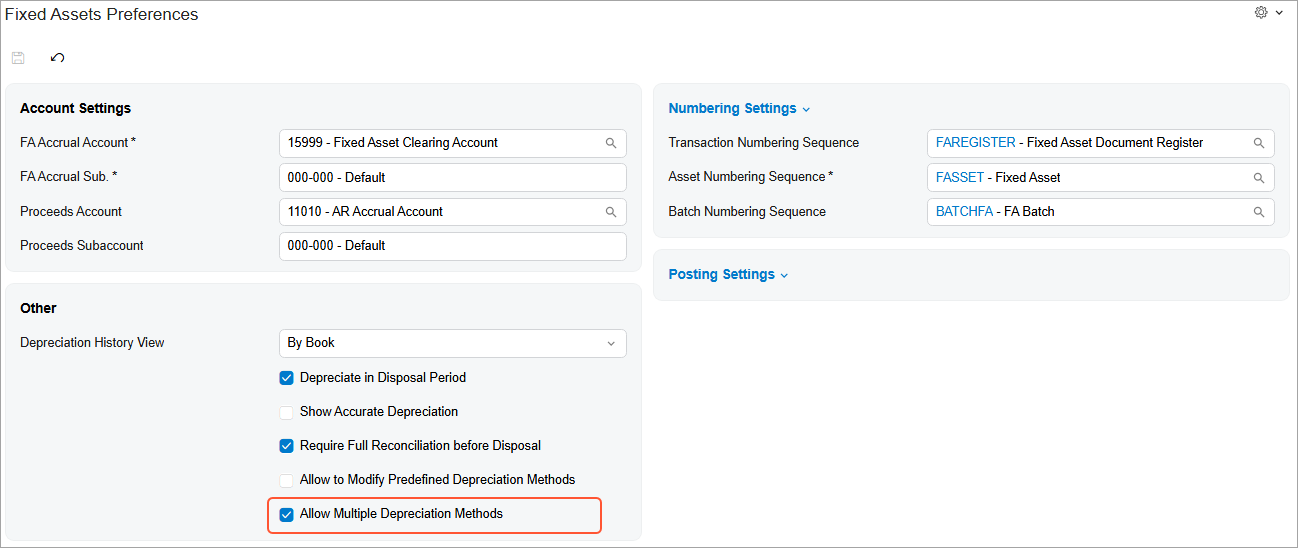
Attention:You can't clear this check box if any non-reversed assets already use multiple methods. - Turn on multiple-method tracking for any needed book.
On the Fixed Assets (FA303000) form, turn on multiple-method tracking for any book by selecting the new Multiple Methods check box on the Balance tab. (Each row in the table represents a book.)
When you select the Multiple Methods check box, the new Applicable Methods table appears at the bottom of the Balance tab. In this table, you define the method schedule for the selected book.
Figure 2. The new UI elements on the Fixed Assets form 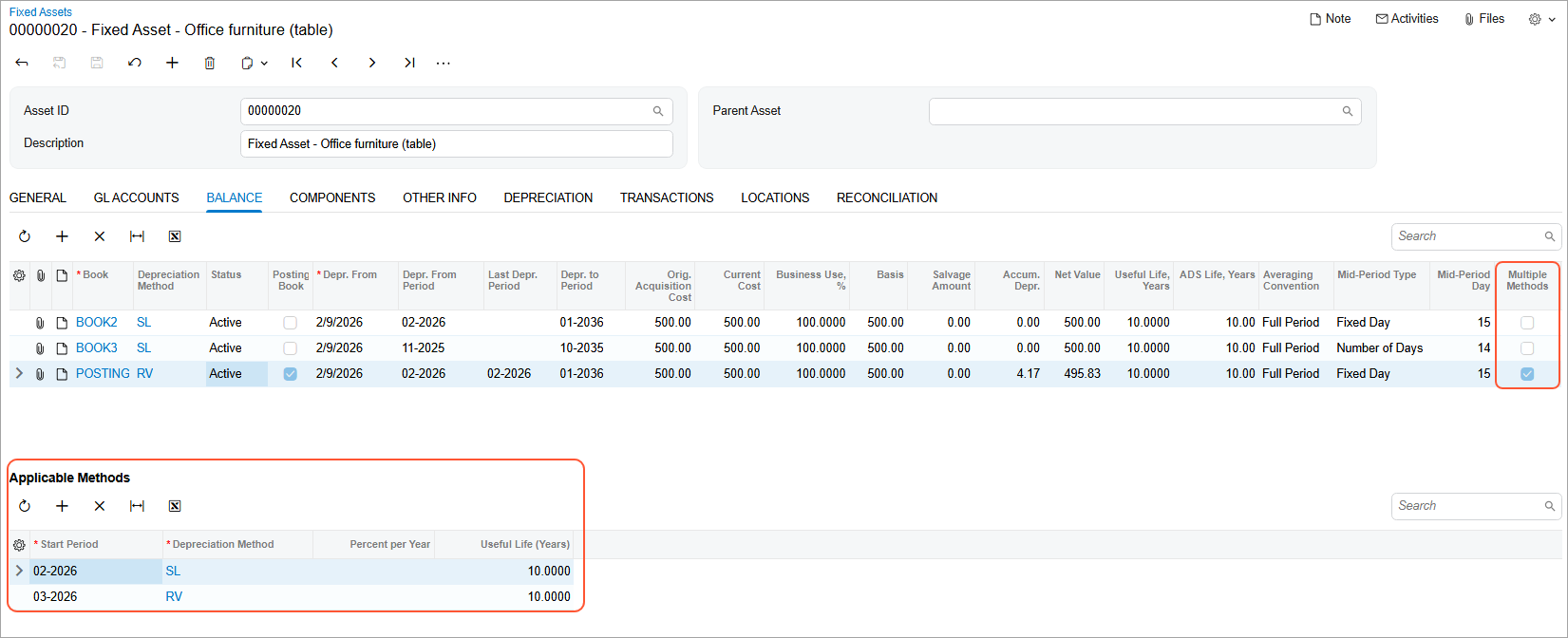
Defining Applicable Methods
In the Applicable Methods table, you define each depreciation method that will apply during the asset’s life cycle for that book. Each row is associated with a start period.
Key points to know:
- The Start Period of the first row is copied from the asset’s Depr. From Period and can’t be changed.
- You can add additional methods for later periods. (Each additional method must have a unique Start Period within the asset’s depreciation range.)
Changing the Depreciation Method for Future Periods
To apply a new depreciation method starting in a future period:
- Open the fixed asset on the Fixed Assets (FA303000) form.
- In the Applicable Methods table on the Balance tab, add a new row.
- In the Start Period column, specify the first period in which the new method should apply.
- In the Depreciation Method column, select the needed method.
- Specify related settings, such as Percent Per Year, where applicable.
Conditions and System Safeguards
When you work with multiple depreciation methods, certain conditions must be met. The system also applies safeguards to protect previously posted depreciation and keep depreciation schedules consistent.
When the Multiple Methods Check Box Is Unavailable
You can't select this check box if:
- The system doesn’t support the combination of the current depreciation method and averaging convention.
- The asset has the Depreciable check box cleared on the General tab of the Fixed Assets (FA303000) form.
- The asset's Placed-In-Service Date is still editable. This indicates that the asset must be depreciated at least partially for the book, which will make that date non-editable.
- The asset's status is Fully Depreciated, Disposed, or Reversed.
Tip:If the asset is fully depreciated in one book but not in another and still has the Active status, you can edit the list of applicable methods in all the asset’s books, including the one where the asset is fully depreciated.
The following rules apply to the list of applicable methods:
- You can delete any row in the Applicable Methods table except the first one with the earliest Start Period.
- If the table contains more than one method, the Multiple Methods check box becomes selected and unavailable. Thus, to return to a single method, you must first delete all rows except the first one.
- If you reduce the asset’s useful life so that the depreciation end period would fall earlier than the last method's Start Period, the system will block the change and tell you to adjust the method list first.
Assets Under Construction
If an asset class has the Under Construction check box selected on the Fixed Asset Classes (FA201000) form, you can't configure multiple methods for any asset of this class. You must move the asset to a class that isn't under construction before you can add multiple methods.
Net Value and Salvage Amount
Regardless of whether an asset is depreciated by using a single method or multiple methods, depreciation stops in either of the following cases:
- The asset’s net value is less than its salvage amount.
- The net value has a sign opposite that of the salvage amount.
Independent Adjustment of the Useful Life and Percent Per Year
You can adjust the Useful Life, Years setting on the Fixed Assets (FA303000) form independently for all methods. Changing the Percent Per Year setting doesn't automatically recalculate the useful life anymore. This change affects New Zealand and Australian depreciation methods.
For straight-line methods, two situations are possible:
- If the useful life is longer than
100 / Percent Per Year, the asset will be fully depreciated before the useful life ends. The remaining periods will have no depreciation. - If the useful life is shorter than
100/Percent Per Year, the whole remaining value is depreciated in the last period.
Learn More
For more information, see Asset Depreciation: Multiple Depreciation Methods for One Asset.