
Service Orders with Items to Be Purchased: General Information
A purchase order can be created from a service order when the required stock items are not available in any of your company’s warehouses, or when certain services or non-stock items are provided by a vendor.
This topic describes the steps involved in processing a service order together with one or more related purchase orders.
Learning Objectives
In this chapter, you will learn how to do the following:
- Create a service order with an item to be purchased
- Create a purchase order for an item in a service order
- Process a purchase order linked to a service order
Applicable Scenarios
You create a service order and then generate a purchase order from it when your company needs to use stock items during an appointment but must first purchase those items from a vendor because they are not available in any warehouse.
Process Diagram
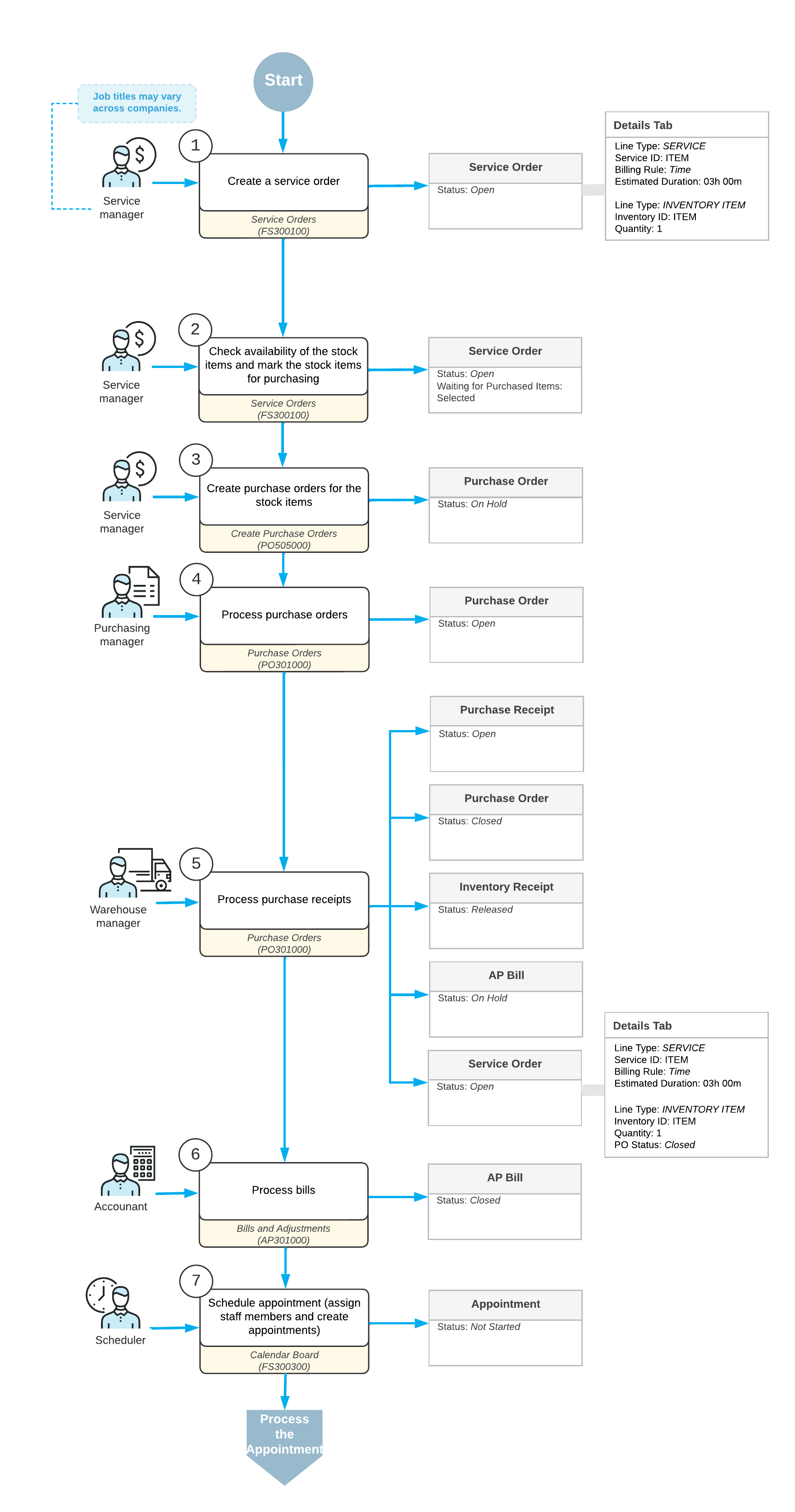
In the diagram below, you can see the entire workflow of processing a service order and the related purchase order. The sections below describe the steps of this workflow in more detail.
Creating a Service Order
When a service manager receives a customer request for services, the manager creates a service order with the Open status on the Service Orders (FS300100) form. In the service order, the manager specifies details such as the customer who submitted the request, the branch and branch location, the services to be performed, and any stock items that need to be purchased for the job.
As part of this step, the service manager checks the availability of the required stock items in the warehouse by selecting the warehouse and an inventory item in the corresponding columns on the Details tab. For any items not available in the warehouse, the manager selects the check box in the Mark for PO column. When at least one item is marked for purchase, the system automatically selects the Waiting for Purchased Items check box in the Summary area of the form, indicating that the service order includes items to be received.
Creating Purchase Orders
After confirming that all necessary items are marked for purchase from the appropriate vendors, the service manager clicks Create Purchase Orders on the More menu of the Service Orders (FS300100) form. This actions opens the Create Purchase Orders (PO505000) form, where the manager reviews the vendors and vendor locations for the items and creates the required purchase orders.
The system creates purchase orders of the Normal type with the On Hold status on the Purchase Orders (PO301000) form. The service manager can then monitor the reference number and statuses of the related purchase orders in the PO Nbr. and PO Status columns on the Service Orders or Service Order Details (FS401000) form.
Processing Purchase Orders
When the purchased stock items are received, the receiving clerk creates and processes a purchase receipt on the Purchase Receipts (PO302000) form. Once purchase receipts have been released for all items in a purchase order, the system changes the purchase order status to Closed and generates a corresponding inventory receipt with the Released status. The receiving clerk can view this receipt on the Receipts (IN301000) form. At this point, the stock items are available to be added to appointments.
The system also creates a bill with the On Hold status. An accountant now can process the bills related to the purchase orders on the Bills and Adjustments (AP301000) form.
Creating Service Appointments
After the purchase order has been processed, the service manager schedules the necessary appointments to perform the customer’s requested services.
When assigning staff members to appointments, the service manager considers their work schedules, as well as skills, licenses, and the service area. On the Appointments (FS300200) form, the service manager reviews each appointment and records additional information, such as the resource equipment used to perform the services. Each appointment is assigned the Not Started status when created.
The subsequent processing workflow of the service order and its appointments follows the same steps as the general workflow for standard service orders.