
Preparation for the MYOB Acumatica Installation: System Environment
Before proceeding with the installation of MYOB Acumatica, make sure that the environment configuration on the computer where you plan to install the server software part of MYOB Acumatica is properly set up.
This topic provides an overview of the configuration of Internet Information Services (IIS) web server features, the specification of HTTPS settings, and the installation of semantic search for Microsoft SQL Server.
Configuration of IIS Web Server Features
You need to ensure that the system configuration is suitable for installing the MYOB Acumatica server part and that the following features are enabled on the IIS web server:
- :
- .NET Extensibility 4.8
- ASP.NET 4.8
- ISAPI Extensions
- ISAPI Filters
- WebSocket Protocol
- :
- Default Document
- Static Content
- :
- Dynamic Content Compression
- Static Content Compression
Setting Up HTTPS in an IIS Web Server
When configuring your computer's environment, you need to ensure that HTTPS is being used. HTTPS is a secure communication protocol that encrypts the data exchanged between a client computer and a server, ensuring its security during transmission. This secure connection is essential for various functionality within your system.
The use of HTTPS makes it possible for users to export data from MYOB Acumatica to Microsoft Excel spreadsheets, facilitating automatic updates of the data. Additionally, HTTPS is required for the implementation of single sign-on (SSO) to MYOB Acumatica, which provides users with the ability to access the system seamlessly with their Google or Microsoft accounts.
You need to enable the TLS protocol to establish HTTPS connections in the IIS web server. To do this, you obtain a certificate from a certification authority and then register it with the IIS web server. This certificate is used to encrypt and decrypt the information transferred over the network, ensuring secure communication between the client and the server. For details on enabling the TLS protocol, refer to the IIS documentation.
Enabling Semantic Search for Microsoft SQL Server
MYOB Acumatica provides the full-text search functionality with the following capabilities within your instances:
- Performing semantic searches within SQL databases
- Identifying key phrases in text or documents
- Uncovering similar or related documents
- Offering insights into document similarities or relations
You can use this functionality if semantic search is enabled in Microsoft SQL Server.
If semantic search is not already installed, you can easily add it by installing an update and selecting this feature under Database Engine Services. To install semantic search, go to the Features to Install page during Microsoft SQL Server setup and select Full-Text and Semantic Extractions for Search. For details, see the documentation for Microsoft SQL Server.
Testing of MYOB Acumatica with PostgreSQL
You can now test MYOB Acumatica with PostgreSQL to assess how PostgreSQL’s performance, scalability, and tooling may benefit your environment.
To prepare for testing, perform these steps:
- Deploy a PostgreSQL server that’s locally installed or running in a Docker
container.
To start a PostgreSQL Docker container, use the following command.
podman run --name postgres -e POSTGRES_PASSWORD=Postgres_Password -p 5432:5432 -d postgres:18 - Deploy an MYOB Acumatica instance.To start this process, launch the MYOB Acumatica ERP Configuration Wizard. On the Database Server Connection page, select PostgreSQL Server in the Server Type box and enter the server credentials in the SQL Server Authentication section, as shown below.
Figure 1. Specifying PostgreSQL connection settings 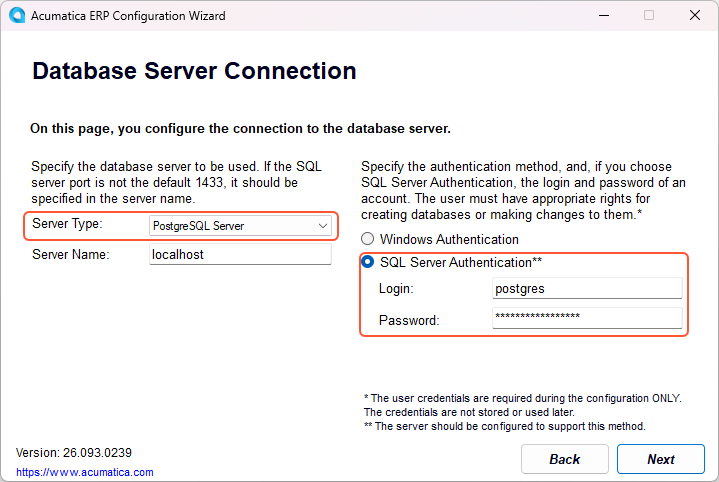
Alternatively, you can use the MYOB Acumatica command-line tool to create and configure the database, as shown in the following example.
ac.exe -cm "DBMaint" -t "PgSql" -s "localhost" -dbsrvuser "postgres" -dbsrvpass "Postgres_Password" -sw "False" -d "database name" -i "AcumaticaERP" -ipath:"instance directory" -c "ci=1;ct=;cp=;cd=;cv=False;cn=;" -c "ci=2;ct=SalesDemo;cp=1;cd=;cv=True;cn=Company;" - Modify the web.config file.
Open the web.config file for the site instance. This file is typically located at %Program Files%\MYOB Acumatica\<instance name>, where <instance name> is the name of the application instance website.
Modify the
connectionStringssection as follows.<connectionStrings> <remove name="ProjectX" /> <add name="ProjectX_PgSql" providerName="System.Data.SqlClient" connectionString="Host=localhost;Database=database name;User ID=postgres;Password=Postgres_Password;Integrated Security=False;" /> </connectionStrings>Modify the
providerssection as follows.<providers> <add name="PXSqlDatabaseProvider" type="PX.Data.PXSqlDatabaseProvider, PX.Data" connectionStringName="ProjectX" companyID="" secureCompanyID="False" /> <add name="PXSqlDatabaseProvider" type="PX.PgSql.PgSqlDatabaseProvider, PX.PgSql" connectionStringName="ProjectX_PgSql" companyID="" secureCompanyID="false" /> </providers> - Save the web.config file. This automatically restarts the site instance.