
GIQL: General Information
Generic Inquiry Query Language (GIQL) is a powerful SQL-like language that streamlines how you create generic inquiries. This section describes the basic principles of GIQL and how to create generic inquiries by using GIQL.
Learning Objectives
In this chapter, you will learn about the following:
- Basic principles of GIQL and GIQL Editor
- How to define a generic inquiry with GIQL
- How to access the GIQL Editor
Applicable Scenarios
You create generic inquiries with GIQL when you want to define or modify a generic inquiry in a code-like format.
Overview of GIQL
GIQL is an SQL-like language meaning that it uses SQL syntax and keywords with a few important differences:
- You reference DACs and DAC fields instead of database tables. That means you can use both database-bound and unbound DACs and DAC fields.
- You can use another generic inquiry as a data source in your query and reference fields of a generic inquiry.
- GIQL queries start with FROM, not SELECT.
Here’s a sample GIQL query that selects AR transactions for a specific salesperson within a date range.
FROM SalesPerson
INNER JOIN ARTran
ON SalesPerson.SalesPersonID = ARTran.SalesPersonID
WHERE (StartDate IS NULL
OR ARTran.TranDate >= StartDate)
AND (EndDate IS NULL
OR ARTran.TranDate <= EndDate)
AND (SalespersonID IS NULL
OR SalesPerson.SalesPersonID = SalespersonID)
ORDER BY SalesPerson.SalesPersonCD
SELECT MAX(SalesPerson.SalesPersonCD),
MAX(SalesPerson.Descr),
MAX(ARTran.TranDate) AS 'Invoice Date',
SUM(ARTran.TranAmt) AS 'Invoiced Sales'
By using GIQL, you can define the same components of a generic inquiry that you would configure on the following tabs of the Generic Inquiry form:
- Data Source
- Relations
- Parameters
- Conditions
- Grouping
- Sort Order
- Results Grid
GIQL Editor
To define and modify generic inquiries, MYOB Acumatica provides the GIQL Editor. The GIQL Editor provides a rich text box where you can write your queries directly.
GIQL Editor includes several intelligent assistance features:
- Syntax highlighting: For easy readability, the editor color-codes query components, such as keywords, entities, properties, aggregate functions and parameters.
- Interactive infotips: When you hover over an entity, such as a DAC or a DAC field,
the editor shows helpful information about it (see below).
Figure 1. Details of a DAC in an infotip 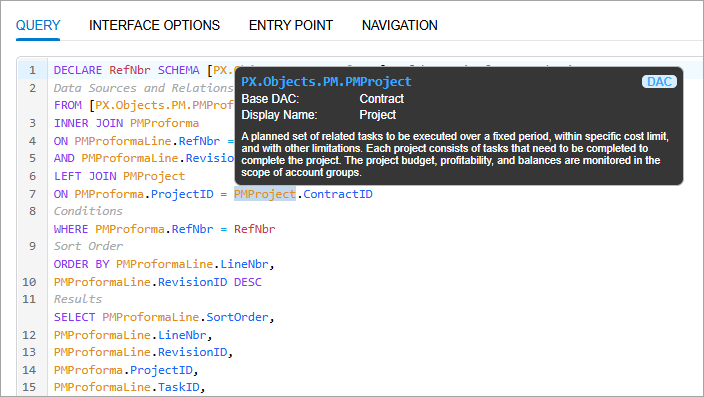
If a field comes from a formula in another generic inquiry, the GIQL Editor generates a readable name for this field and shows the full formula in the infotip, as shown below.
Figure 2. The infotip for the formula field 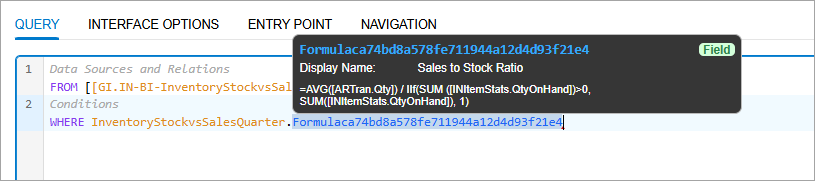
- Real-time validation: The editor checks your syntax and semantics as you type,
validates entities, and makes sure they exist. It also highlights errors, as you can see
below.
Figure 3. A semantic error in the GIQL Editor 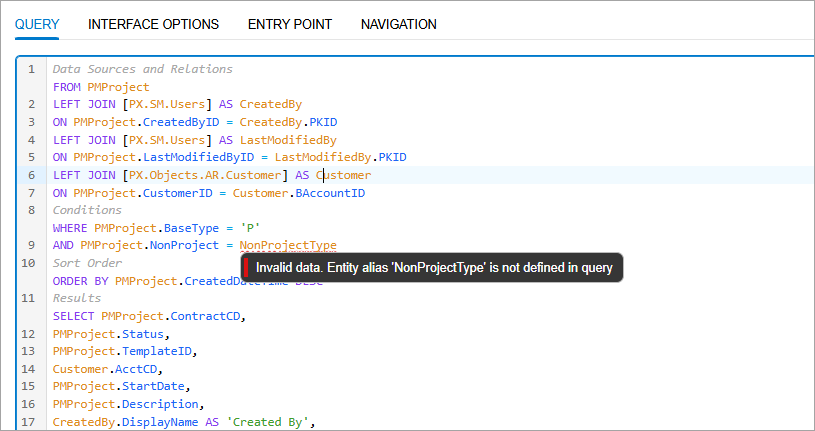
- Auto completion: The editor shows valid entities (see below) depending on the current
context and cursor position.
Figure 4. A list of suggestions 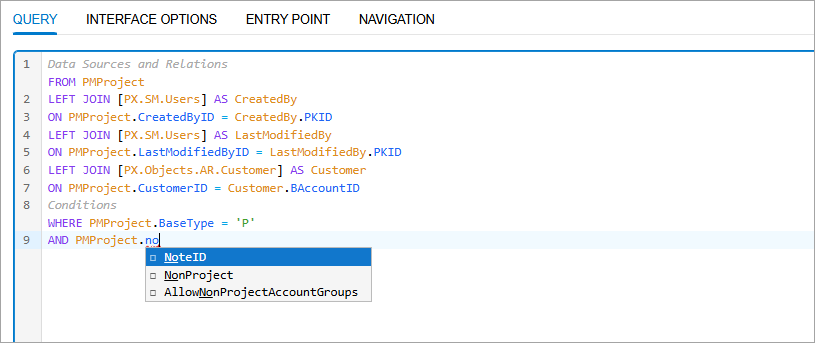
- Automatic organization: As you type your query, it automatically organizes your code
into these generic inquiry components, as shown below:
- Data sources and relations
- Conditions
- Grouping
- Sort order
- Results
Figure 5. The GIQL Editor 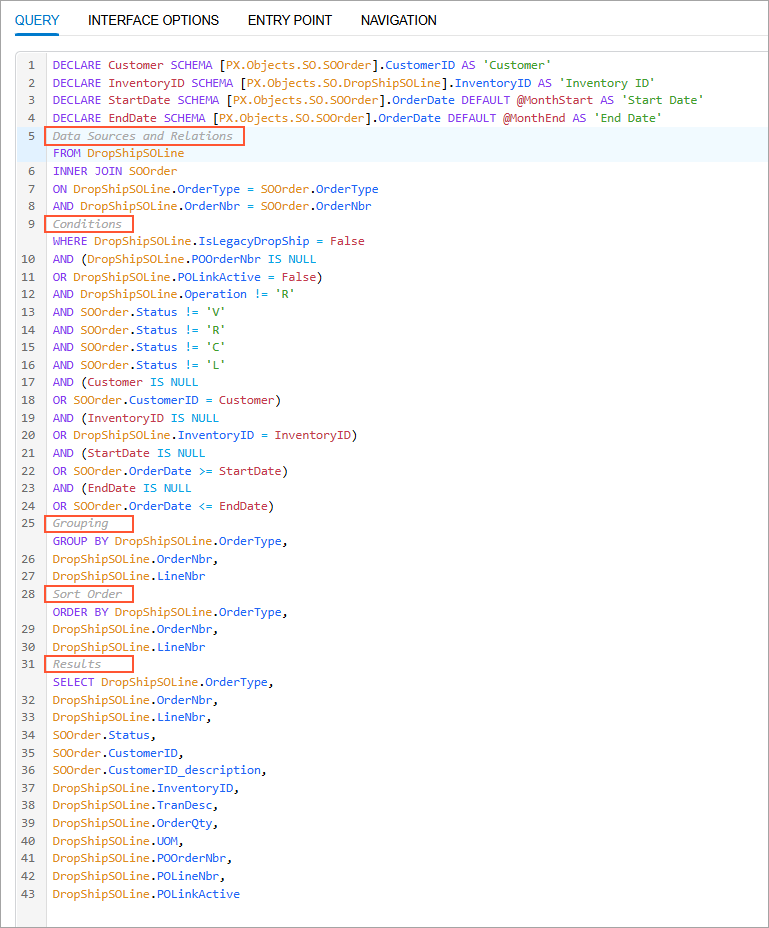
Where You Can Use GIQL
You can access the GIQL Editor and write GIQL queries on the Generic Inquiry (SM208000) form: In the Summary area, select Advanced as the mode. The Query tab appears with the GIQL Editor, as shown below.
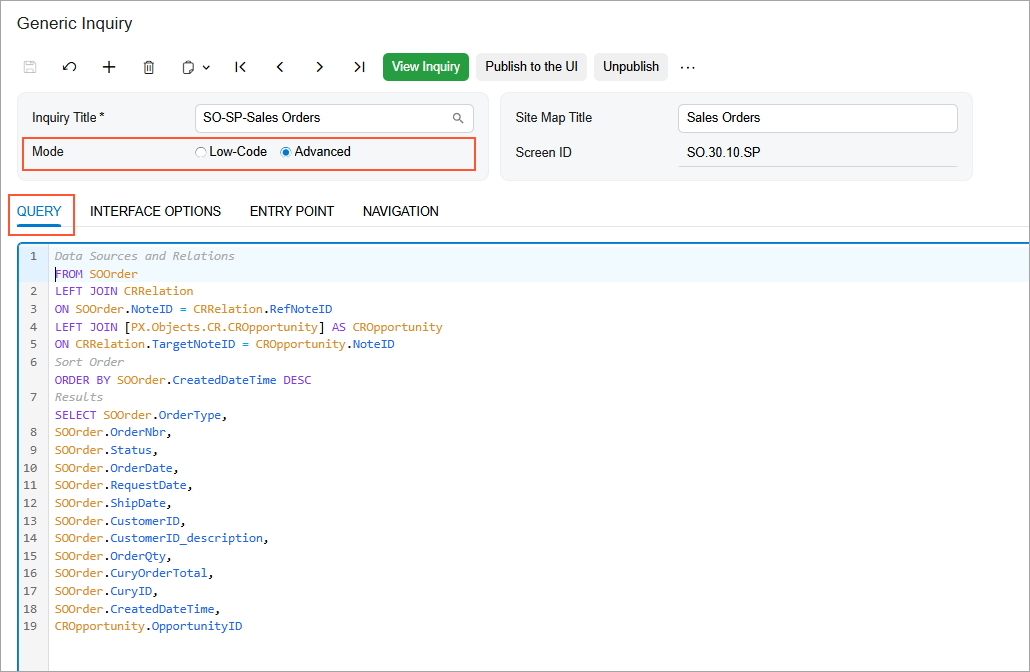
Everything you write in the GIQL Editor is also available in the Low Code mode so that you can switch between the mode while editing the inquiry.